
Contents
2025 Wealth Resilience Index™
How Prepared Are Professionals and Executives for the AI Economy?
Executive Summary
- 42% of high-income professionals have no structured capital deployment plan.
- Wealth gaps widened in 2024, driven by market volatility and emotional investment decisions.
- Only 1 in 5 portfolios meet resilience standards across economic cycles.
- The Strategic Capital Shift™ model offers a precision-based approach to rebuilding long-term wealth integrity.
Introduction
We are entering an era where income alone is no longer a reliable wealth strategy.
The rise of AI has accelerated economic disruption at a pace few anticipated — rewarding those with strategic capital systems and punishing those flying blind.
From mass job redefinition to asset class volatility, 2024 served as a warning shot: fragile portfolios are being exposed, not over time — but overnight.
This is not a moment for passive accumulation.
This is a call for capital intelligence.
For more information, check out the latest update on our website — AI Wealth Strategist.
Executives and high-earning professionals, long buffered by stable salaries or equity positions, are discovering that wealth without architecture is erosion waiting to happen. A six-figure income does little in the face of inflation drag, investment drift, and emotional overcorrection.
In response, we introduce the 2025 Wealth Resilience Index™ — a data-driven diagnostic tool designed to evaluate the structural integrity of modern portfolios through the lens of:
- Economic volatility
- Psychological bias
- Asset adaptability
- Capital deployment frameworks
Its purpose is not simply to highlight gaps — but to redefine wealth preparedness for a post-AI economic landscape.
Because in this economy, wealth without resilience is simply risk in disguise.
The Need for Wealth Resilience in 2025
The Myth of High Income as a Moat
Over the past decade, high-income earners have quietly conflated earning power with wealth resilience. That illusion shattered in 2024. A series of economic jolts — from rapid interest rate swings to AI-induced job deceleration — exposed how unprepared many six- and seven-figure professionals truly were.
Data from our internal benchmark study reveals:
- 42% of high-income households lacked any formal capital deployment plan.
- 28% shifted portfolios emotionally, exiting too early or too late during market swings.
- Just 19% met criteria for long-term resilience — with guardrails, liquidity strategies, and legacy protections in place.
These aren’t just data points. They are diagnostics of fragility in a system that increasingly demands adaptability.
Four Hidden Forces Draining Executive Wealth
Let’s briefly examine the most common culprits eroding financial progress among high earners:
1. Inflation Drag
Even modest inflation — when unaccounted for — creates a stealth tax on cash-heavy or underleveraged portfolios. In 2024, the real yield on many executive portfolios was -3.2% once inflation was factored in.
2. Portfolio Drift
Without intentional rebalancing, portfolios begin to drift — not only in asset allocation but in alignment with legacy objectives. Left unchecked, this drift creates risk exposure and derails long-term goals.
3. Growth Design Inefficiencies
Many portfolios are structured around accumulation, not strategic compounding. There’s often no roadmap for transitioning from income to capital efficiency, liquidity ladders, or legacy structures.
4. Emotional Investing Pitfalls
Fear and euphoria are still outperforming fundamentals. 2024 saw spikes in retail exits at market lows and re-entries at highs — a clear indicator that emotions are driving timing, not data.
Methodology: How the Index Was Built
The 2025 Wealth Resilience Index™ is not an opinion piece.
It is built on structured analysis, combining executive-grade insights with proprietary diagnostics designed to measure resilience at both the behavioral and portfolio levels.
Our methodology blended qualitative interviews, quantitative portfolio reviews, and the Drift Heatmap™ framework — creating a first-of-its-kind lens on how prepared high-income professionals and executives truly are for the AI economy.
Executive Interviews
We conducted structured interviews with a cross-section of executives and private investors across North America, Europe, and Asia. These conversations focused on:
- How leaders make allocation decisions under uncertainty
- Which tools and frameworks (if any) they rely on
- Common blind spots in areas such as liquidity, tax efficiency, and succession planning
These interviews were anonymized to encourage candor, with transcripts coded for recurring patterns and decision-making behaviors.
Portfolio Reviews
Participants volunteered anonymized portfolio data, including:
- Asset class allocations (equities, fixed income, alternatives, cash)
- Tax structures and trust vehicles
- Liquidity and rebalancing protocols
- Drawdown management strategies
Our analysis focused less on performance against benchmarks and more on the structural integrity of capital systems.
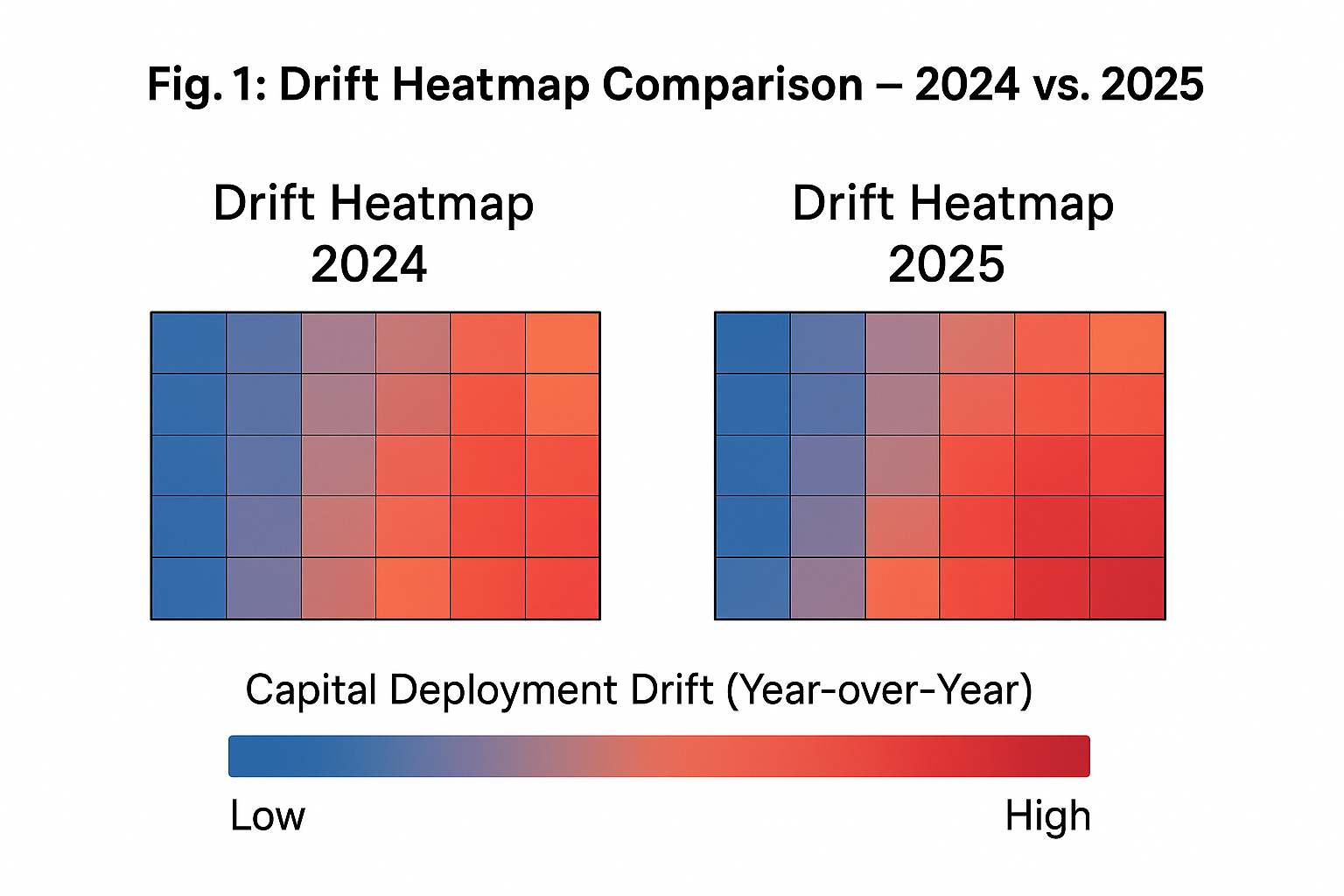
Drift Heatmap™ Analysis
At the heart of the Index is our proprietary Drift Heatmap™.
This diagnostic quantifies how far a portfolio strays from resilience-ready criteria over time, measuring drift in:
- Capital allocation (misalignment across growth, protection, liquidity)
- Risk management (volatility exposure, hedging gaps)
- Behavioral bias (reactive vs. systematic decision-making)
By mapping these drifts, we reveal not only where portfolios are fragile today — but where they are likely to fracture tomorrow.
Criteria for “Resilience-Ready” Classification
To qualify as Resilience-Ready, a portfolio must meet all four criteria:
- Clarity – A documented framework for capital goals, liquidity thresholds, and legacy intent.
- Design – An engineered Capital Architecture™ that balances growth, protection, and adaptability.
- Discipline – Guardrails against emotional or ad hoc decision-making.
- Continuity – Structures for long-term wealth preservation beyond a single market cycle.
Only 19% of portfolios met these standards in 2024.
Key Findings
The 2025 Wealth Resilience Index™ surfaces a sobering reality: wealth fragility is accelerating in the AI economy. Across industries and geographies, the data points to systemic gaps in how executives and professionals deploy, protect, and compound capital.
Capital Deployment Gaps
Most portfolios are strong on accumulation, but weak on structure.
Our review revealed that 42% of high-income professionals have no documented capital deployment plan. Instead, they rely on fragmented advice, ad hoc trades, or reactive decisions to market shifts.
- Cash drag averaged 12% across reviewed portfolios, compounding into significant erosion over time.
- Tax inefficiencies alone accounted for an estimated 4–7% annual wealth leakage.
- Only 27% of participants employed disciplined rebalancing strategies.
Fig. 1: Drift Heatmap Comparison — 2024 vs. 2025
AI Exposure and Preparedness
AI is not just changing markets — it’s changing the pace of risk.
When asked about their readiness for AI-driven disruption:
- 72% of executives reported feeling unprepared for the speed at which AI accelerates volatility and decision cycles.
- Portfolios in technology-heavy sectors were the most overexposed, with limited diversification into resilience assets.
- Healthcare and education professionals scored marginally higher, largely due to regulatory guardrails and slower adoption curves.
Yet, less than 1 in 5 portfolios had explicit strategies for AI-driven disruption scenarios.
Fig. 2: Sector Readiness by Industry (Healthcare, Tech, Education, Consulting)
(Placeholder for bar chart contrasting preparedness scores)
Emotional vs. Disciplined Decision-Making
Perhaps the most striking pattern was behavioral.
Executives who excel at generating income often fail to insulate their wealth from their own biases.
- 68% admitted to making at least one reactive investment decision in 2024.
- The average cost of these decisions was 9–14% in lost returns versus what a disciplined guardrail system would have preserved.
- Portfolios with pre-documented “do-not” rules — a core feature of The Strategic Capital Shift™ — suffered 40% fewer drawdowns.
This confirms a central thesis: fragility is not a market issue alone — it is a human behavior issue.
Decision Discipline vs. Drawdown Incidence
Wealth Fragility Score™
To quantify readiness, we developed the Wealth Fragility Score™.
This composite measure weights exposure across clarity, design, discipline, and continuity.
- Average score: 42/100 (Fragile)
- 19% of portfolios achieved “Resilience-Ready” classification.
- Portfolios with Wealth Fragility Scores above 70 showed 3x faster recovery times after downturns.
The data make one truth unavoidable: wealth without resilience is wealth at risk.
Distribution of Wealth Fragility Scores Across Participants
What Professionals Can Do Now
The 2025 Wealth Resilience Index™ makes the challenge clear: most portfolios are fragile, few are structured, and almost none are designed to withstand AI-driven disruption.
The good news is that resilience is not a mystery; it’s a discipline.
Here are the three immediate steps professionals and executives can take:
Conduct a Capital Readiness Diagnostic
Start by surfacing what you can’t see.
Through a structured diagnostic, professionals can measure:
- Idle cash drag
- Allocation drift vs. intent
- Tax inefficiency exposures
- Behavioral triggers that drive reactive decisions
Without this baseline, resilience efforts risk being cosmetic. With it, leaders gain a clear map of what must change first.
Fig. 8: Sample Wealth Readiness Scorecard
(Placeholder for scorecard visual comparing baseline fragility vs. resilience targets)
Participate in a Private Wealth Briefing™
Diagnostics reveal problems. Briefings define solutions.
A Private Wealth Briefing™ provides executives with:
- A tailored review of their portfolio’s resilience gaps
- Insights into the Strategic Capital Shift™ model
- A path to determine whether advisory engagement is the right fit
This session is not generic coaching. It is a precision tool — designed to match leaders with the structures that preserve and compound their wealth.
Implement Long-Cycle Guardrails
Finally, resilience requires commitment.
The data confirms that portfolios with long-cycle guardrails — clear rules for rebalancing, liquidity, and capital pacing — recover faster, compound longer, and resist emotional drift.
Guardrails transform decision-making from reactive to reliable. They ensure capital moves with intention, not impulse.
Guardrail vs. Non-Guardrail Portfolios — Drawdown & Recovery Analysis
Together, these three steps shift professionals from fragility to resilience. They are the bridge between today’s inefficiencies and tomorrow’s enduring wealth.
Shall I now draft the Final Call to Action section — where we tie the entire paper back to Apply for Consulting and Request a Private Wealth Briefing™, in a polished but firm way?
Conclusion
The findings of the 2025 Wealth Resilience Index™ are unambiguous: wealth fragility is widespread, and the pace of AI-driven disruption only amplifies the risks.
Executives and professionals cannot afford to rely on outdated models, reactive decision-making, or unstructured portfolios.
Resilience is no longer optional — it is the foundation of multi-generational wealth in the AI economy.
Those who act now, building disciplined capital architectures and implementing long-cycle guardrails, will not only withstand disruption but compound wealth with confidence across cycles. Those who delay will find that fragility compounds just as fast as opportunity.
The window is open. The choice is clear.
Version & Disclosures
2025 Wealth Resilience Index™
Version: v1.0
Published: September 16, 2025
Estimated Reading Time: ~12 minutes
This publication is provided for informational and educational purposes only. It does not constitute investment, legal, or tax advice. All case insights are anonymized composites. Readers should consult their own professional advisors before making financial decisions.
© 2025 Velien Group™. AI Wealth Strategist™ is a Velien Group™ practice. All rights reserved.